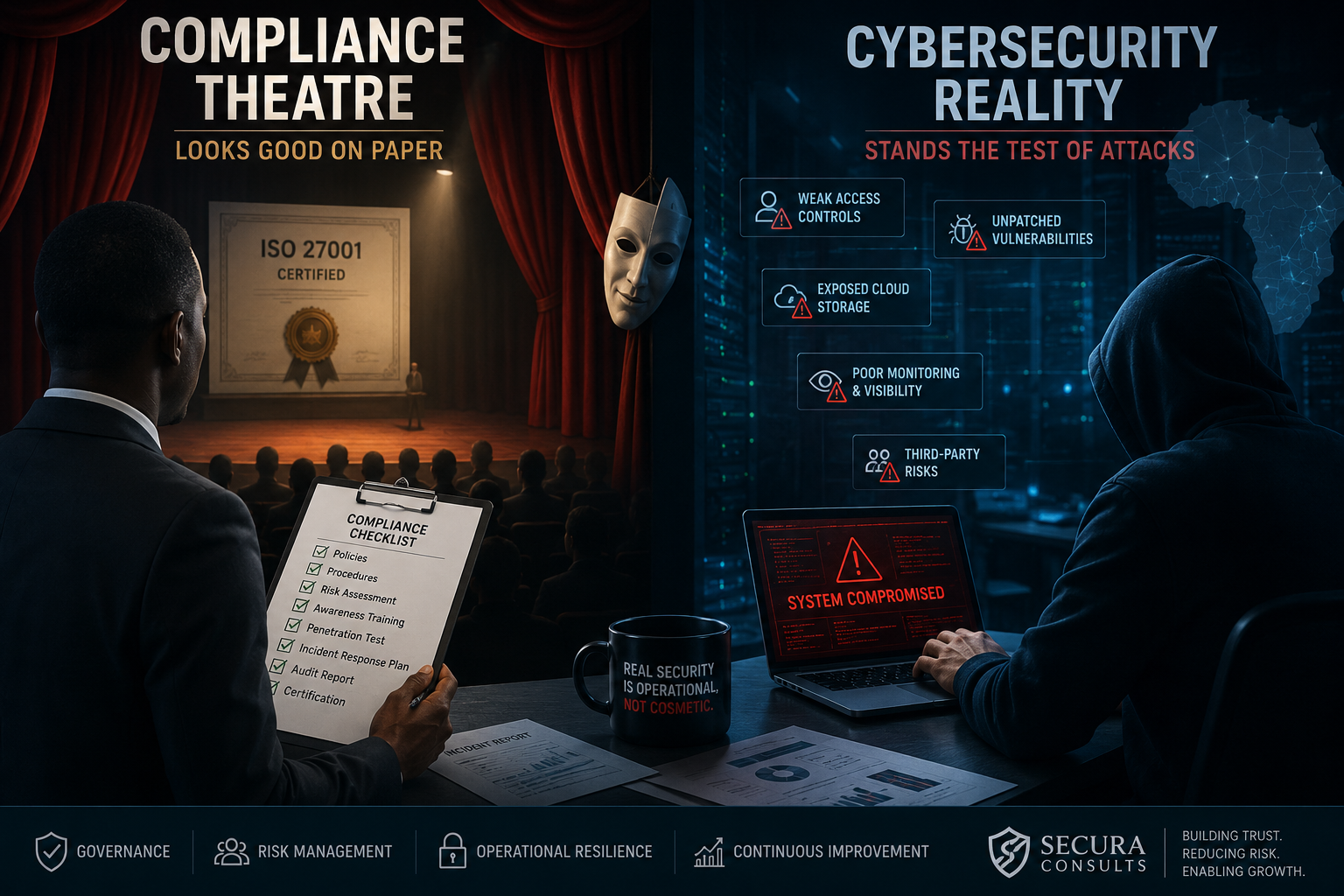
Across Africa’s rapidly growing digital economy, cybersecurity conversations have become louder, boardrooms are more aware, regulators are more active, and organizations are investing more in “security.” Yet beneath the surface, many organizations are operating in a dangerous state of compliance theatre — appearing secure without actually being resilient.
This is becoming one of the most overlooked cybersecurity risks in the continent.
From fintechs and telecoms to government institutions and healthcare providers, many organizations now possess security policies, compliance certificates, awareness presentations, penetration test reports, and vendor questionnaires. On paper, everything appears mature. In reality, many environments remain operationally fragile.
The problem is not always the absence of security controls. Increasingly, the problem is the absence of effective security governance.
Organizations are building cybersecurity programs designed to satisfy auditors, customers, investors, or regulators — instead of programs designed to withstand real attacks.
The Rise of “Checkbox Security”
Many organizations today can successfully pass a compliance assessment while still remaining highly vulnerable operationally.
This happens because compliance frameworks are often treated as documentation exercises rather than operational disciplines.
Examples are everywhere:
- Security policies that employees never read
- Incident response plans that have never been tested
- Multi-factor authentication enabled only for executives
- Vulnerability assessments performed once yearly solely for audit purposes
- Shared administrator accounts still being used in production environments
- Critical cloud resources deployed without continuous monitoring
- Third-party vendors onboarded without meaningful security due diligence
- Security awareness programs reduced to annual PowerPoint sessions
The organization becomes compliant on paper but insecure in practice.
Cybercriminals do not attack policy documents. They attack operational weaknesses.
Why This Problem Is Growing in Africa
Africa’s digital transformation is accelerating faster than its institutional cybersecurity maturity. Fintech expansion, digital identity systems, cloud adoption, mobile banking, e-commerce growth, and government digitization are creating enormous attack surfaces. At the same time, many organizations are still developing foundational governance capabilities.
Several factors contribute to this challenge:
1. Compliance Pressure Without Security Culture
Many organizations pursue compliance because customers, investors, or regulators demand it. That is understandable. However, when compliance becomes the goal rather than the baseline, security programs become superficial.
The objective shifts from:
“Are we secure?”
to:
“Can we pass the audit?”
Those are very different questions.
2. Executive Misunderstanding of Cybersecurity
In many organizations, cybersecurity is still viewed primarily as an IT issue rather than an enterprise risk issue.
As a result:
- Security teams are underfunded
- Governance functions lack authority
- Risk decisions are decentralized
- Security leadership is excluded from strategic planning
Meanwhile, threat actors are becoming increasingly sophisticated and financially motivated.
3. Over-reliance on Certifications
Frameworks such as ISO 27001, PCI DSS, SOC 2, and local data protection regulations are important. However, certification alone does not guarantee security maturity.
An organization can hold certifications and still:
- Mismanage privileged access
- Fail to detect insider threats
- Lack visibility into cloud environments
- Ignore logging and monitoring
- Have weak incident response capabilities
Compliance should validate operational maturity — not replace it.
4. Rapid Cloud Adoption Without Governance
Cloud adoption across African organizations is increasing rapidly, especially among startups and fintechs. Unfortunately, governance maturity often lags behind deployment speed.
Common issues include:
- Poor identity and access management
- Excessive permissions
- Exposed storage buckets
- Weak API security
- Lack of cloud security posture management
- Inadequate secrets management
In many cases, organizations inherit the scalability of the cloud without inheriting the discipline required to secure it.
The Cost of Compliance Theatre
The consequences are becoming more severe.
When breaches occur, organizations often discover that:
- Their monitoring capabilities were inadequate
- Their backup strategies were incomplete
- Their incident response processes were theoretical
- Their vendor dependencies were poorly understood
- Their executives underestimated cyber risk exposure
The financial impact extends beyond direct losses.
Organizations may face:
- Regulatory penalties
- Customer distrust
- Operational downtime
- Reputational damage
- Investor concerns
- Contractual liabilities
- Litigation exposure
In regulated sectors such as banking, fintech, healthcare, and telecommunications, the long-term reputational impact can be devastating.
What Real Cybersecurity Maturity Looks Like
True cybersecurity maturity is not measured by the number of policies an organization possesses. It is measured by operational resilience.
Mature organizations typically demonstrate the following characteristics:
Security Is Embedded Into Governance
Cybersecurity is treated as a business risk issue, not merely a technical issue.
Boards and executives:
- Understand cyber risk exposure
- Participate in governance decisions
- Review security metrics regularly
- Support security investments strategically
Security Controls Are Operationalized
Controls are not merely documented; they are continuously tested and monitored.
Examples include:
- Regular access reviews
- Continuous vulnerability management
- Security logging and monitoring
- Real incident simulations
- Tabletop exercises
- Third-party risk assessments
- Security testing integrated into development pipelines
Identity Is Treated as the New Security Perimeter
Modern attacks increasingly target identities rather than infrastructure.
Mature organizations prioritize:
- MFA everywhere possible
- Privileged access management
- Zero Trust principles
- Conditional access policies
- Continuous identity monitoring
Security Is Continuous, Not Annual
Cybersecurity is not a once-a-year audit activity.
It is an ongoing operational discipline requiring:
- Continuous monitoring
- Continuous improvement
- Continuous governance review
- Continuous staff awareness
- Continuous adaptation to emerging threats
The Future of Cybersecurity in Africa
Africa’s digital economy will continue expanding aggressively over the next decade.
That growth creates extraordinary opportunities — but also extraordinary risk concentration.
The organizations that will succeed long-term are not necessarily those with the most impressive compliance reports. They are the organizations capable of building sustainable trust.
Trust is now a competitive advantage.
Customers, regulators, investors, and partners increasingly evaluate organizations based on:
- Security maturity
- Governance discipline
- Privacy accountability
- Operational resilience
- Incident response capability
The era of symbolic cybersecurity is ending.
Organizations must move beyond performative compliance and begin building security programs that function effectively under real-world pressure.
Because eventually, every organization gets tested.
The only question is whether their cybersecurity program was designed for audits — or designed for reality.
Secura Consults helps organizations build practical, regulator-aligned cybersecurity, privacy, and technology risk programs focused on operational resilience — not just compliance optics.