For SaaS platforms and fintech companies, ISO/IEC 27001 is rarely pursued for symbolic reasons. It is typically driven by external pressure—enterprise procurement requirements, bank onboarding, investor due diligence, or regulatory scrutiny. Increasingly, customers expect demonstrable evidence of structured security governance rather than informal security practices.
ISO/IEC 27001 provides a framework for establishing an Information Security Management System (ISMS). It is not merely a set of policies or a technical control checklist. It is a management system that integrates risk assessment, governance, operational controls, and continuous improvement into the organization’s structure.
Certification, where pursued, is conducted by independent accredited certification bodies. Implementation and readiness require disciplined planning and structured execution.
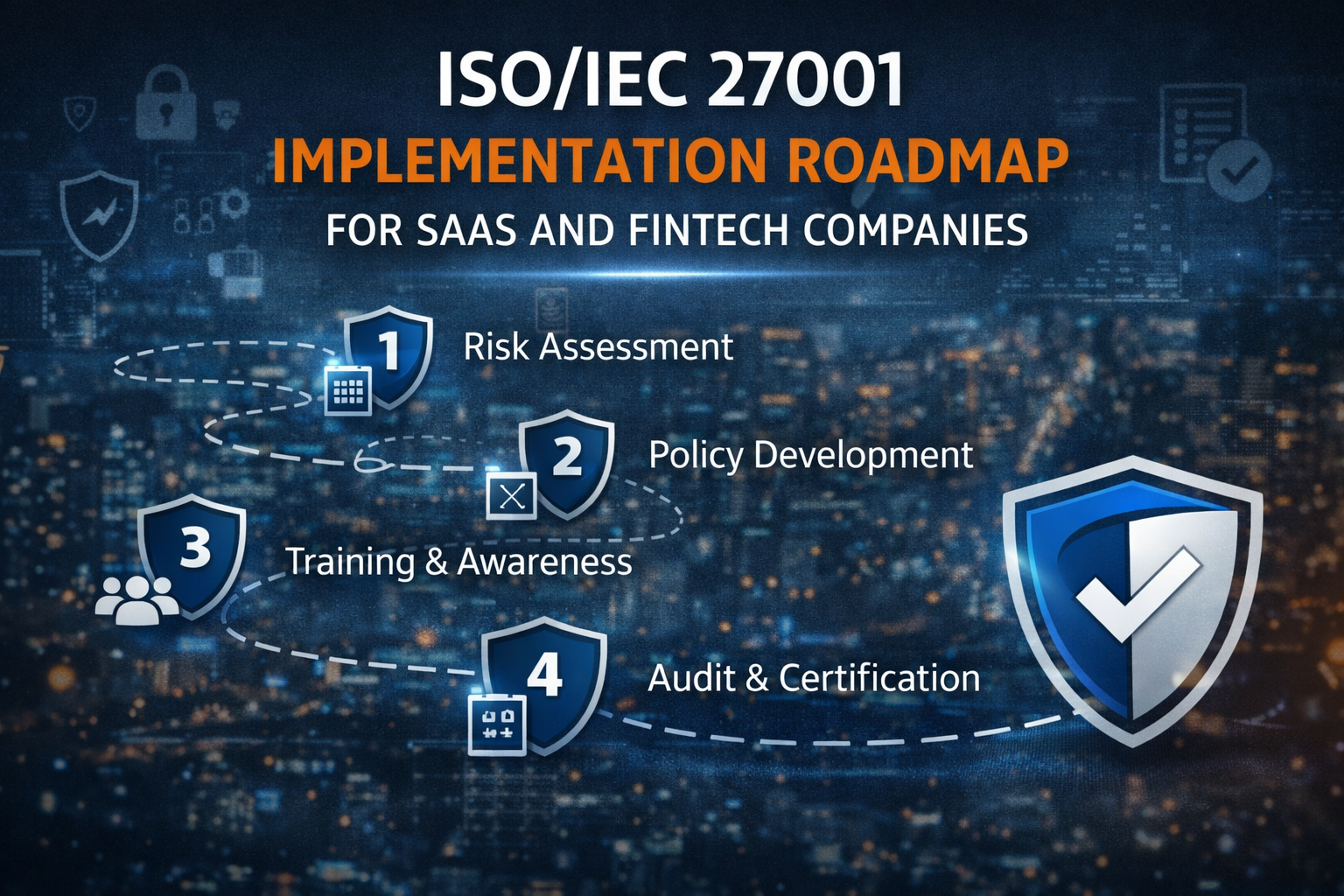
Below is a practical roadmap tailored to SaaS and fintech environments.
1. Define Scope and Organizational Context
The most consequential decision in any ISO 27001 implementation is defining the ISMS scope. For SaaS and fintech organizations, scope typically includes production systems, supporting infrastructure, key personnel, and relevant third-party service providers.
An overly narrow scope may appear convenient but often creates friction during audit stages. An overly broad scope may introduce unnecessary complexity and cost. The objective is to define a scope that reflects material information assets and business risk while remaining operationally manageable.
At this stage, the organization must also document its internal and external context, interested parties, and high-level security objectives.
2. Conduct a Structured Risk Assessment
ISO 27001 is fundamentally risk-driven. The risk assessment process should identify:
- Information assets
- Associated threats and vulnerabilities
- Likelihood and impact
- Existing controls
- Residual risk
For fintech and SaaS companies, risk areas commonly include cloud infrastructure misconfiguration, privileged access misuse, insecure API integrations, weak change management, and third-party dependency exposure.
The output of this stage is a documented risk register and a risk treatment plan. This becomes the foundation of the entire ISMS.
3. Design the ISMS Framework
Once risks are identified, the organization formalizes its ISMS framework. This includes:
- Information security policy
- Defined roles and responsibilities
- Governance structure
- Control objectives aligned with Annex A
- Statement of Applicability (SoA)
The Statement of Applicability is particularly important. It documents which Annex A controls are applicable, which are excluded, and the justification for those decisions. During audits, this document is examined closely.
The ISMS must reflect actual operational practice. Template-driven documentation without operational alignment is one of the most common causes of audit findings.
4. Implement and Operationalize Controls
Controls must move beyond policy statements and become embedded practices. In SaaS and fintech environments, auditors typically expect evidence in areas such as:
- Access management and periodic access reviews
- Secure development and change management procedures
- Logging, monitoring, and incident response processes
- Backup and recovery testing
- Supplier and third-party risk management
Control effectiveness depends on consistent execution. Organizations that treat ISO 27001 as a documentation exercise often struggle when evidence is requested.
5. Internal Audit and Management Review
Before pursuing certification, the organization must conduct an internal audit and a formal management review. The internal audit evaluates whether the ISMS is designed and operating effectively. Management review ensures leadership oversight and accountability.
Common weaknesses at this stage include incomplete evidence records, inconsistent control operation, and inadequate documentation of corrective actions.
This phase is not a rehearsal for certification; it is a governance checkpoint. Organizations that take internal audits seriously are typically more prepared for external scrutiny.
6. Preparing for Stage 1 and Stage 2 Audits
If certification is pursued, the certification body conducts two primary stages:
- Stage 1: Documentation and readiness review
- Stage 2: Control implementation and effectiveness assessment
Preparation should focus on:
- Evidence traceability
- Control consistency
- Clear articulation of risk decisions
- Leadership involvement
Certification bodies make independent determinations. The organization’s responsibility is to demonstrate that the ISMS is established, implemented, maintained, and continually improved.
Common Pitfalls in SaaS and Fintech Implementations
Several recurring issues delay or complicate ISO 27001 journeys:
- Over-reliance on generic policy templates
- Failure to align technical controls with documented processes
- Weak asset inventories
- Inconsistent access reviews
- Poor integration with cloud environments
- Treating ISO 27001 as a procurement checkbox
ISO 27001 is most effective when treated as a governance system that supports business growth and operational resilience.
Integrating ISO 27001 with Privacy and Regulatory Requirements
For organizations subject to NDPA, GDPR, or other data protection regimes, ISO 27001 provides structural alignment but does not replace regulatory obligations. Privacy governance, lawful basis documentation, breach notification processes, and data subject rights handling must be integrated into the broader ISMS framework.
A structured implementation allows security and privacy requirements to operate cohesively rather than as parallel compliance tracks.
Conclusion
ISO/IEC 27001 implementation is not a short-term documentation project. It is a structured governance initiative that strengthens risk management, improves operational discipline, and prepares organizations for audit and regulatory scrutiny.
For SaaS and fintech companies, the value lies not merely in certification, but in building a defensible security framework capable of withstanding customer, investor, and regulatory examination.
Organizations considering ISO 27001 should begin with a structured readiness assessment to understand scope, risk exposure, and implementation complexity before committing to certification timelines.